

There’s an art fun fact making the rounds: The haunting masterpiece called Starry Night was the product of Vincent Van Gogh’s attempt at art therapy, painted while he was stewing in a mental institution.
I didn’t know that. Which is embarrassing since I was the first English-language translator of In the Sky, the 19th-century novel about Van Gogh’s life, written by the churlishly lovable anarchist Octave Mirbeau (my translation is coming back into print this summer thanks to Peter Clarke!).
Mirbeau’s novel was the closest thing to a biography that poor Van Gogh got, prior to when everyone caught on after his suicide.
I also spent my 32nd year of life finally getting a degree in the same town that contains the art museum where Van Gogh came up with the plan of cutting off his ear, Montpellier. This ear plan was presumably fashioned by Van Gogh to make himself feel better—I mean, it’s kind of at the intersection of trans and cutting. Although Mirbeau seemed to think he cut it off in order to punish himself and the world for the fact that it seemed impossible to transmit the signal that was trying so hard to get out of him that it split him open like Sigourney Weaver.
I, however, was more interested in Mirbeau’s attempts to help Van Gogh explain the un-explainable than I was in Van Gogh’s gory life details.
I knew he had probably done time in crazy jail. But I am one of those people who will pick up a classic novel—the kind where a later scholar added an essay full of spoilers and biographical details—and skip all that intro stuff because what kind of psycho wants to read someone else’s opinion of a book before reading the book?
However, I kind of wish I had known this fun fact earlier, because it would have been a great way to push my animated sitcom, A Republic of Idiots.
Which was also conceived in crazy jail.
As little as creative people like pushing their shit—if you need to make something, you need to spend all your time on making it, not talking about making it—the world is what it is. I have finally learned that no amount of noticing that things suck is going to make them stop sucking right now, so some of that creative energy needs to be side-tracked into the foul art of scrounging for attention. So I’m going to use this coincidence:
Van Gogh created his masterpiece in an insane asylum, and I came up with the idea for A Republic of Idiots in an insane asylum. Please send congratulations. This is definitely a parallel.
It feels like cheating, but that’s better than being cheated.
Or being Van Gogh.
God, how can anyone look at a life like that and wish to be an artistic genius?
I can’t think of anything more in line with the 21st-century tradition of being pathologically attention-thirsty as a requirement for every job, including mental patient, than comparing myself to a guy who died penniless and insane, but now his paintings are on billions of those canvas bags that people buy at the museum because they don’t want to forget that at least once they got to go there, even if they have to spend the next four months coding coupons for (I don’t know if I can actually say a food corporation’s name without them sending guys to my door).
But it would be considerably stupid on my part to fail to use this, so here we are.
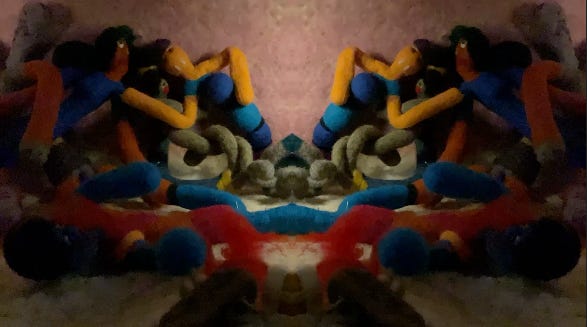
The tech needed to animate this sitcom on my budget didn’t come around till a decade later, but I sketched out the ideas for what became A Republic of Idiots while on a locked ward.
The way that filth hole of hopelessness was run was so absurd that I vowed it would someday be a sitcom, because it was a perfect setting with infinite BS possibilities. Bleak; but Waiting for Godot—the first sitcom, if you ask me—was bleak as well.
During art time one day, I came up with it and started writing it down, giggling, and entertained the other inmates with it for the whole hour—which made me kind of proud. The idea that our lives were so ridiculous that other people would laugh along was cheering. It made us feel human. “We could be on TV!”
Most of us couldn’t even get a diagnosis—we were warehoused as Bad Fruit and fed pills, which were nice, but as soon as your insurance ran out they decided you were OK now and tossed you outside without so much as a prescription, much less a diagnosis. But it was definitely stupid enough to make entertainment.
Watching the kids parade their fifty diagnoses around now like they’re the qualifying rounds of the Oppression Olympics is kind of annoying to those of us who, a mere decade ago, were still unclassified human garbage. You didn’t get special treatment for being crazy; you got fired, locked up, jerked around.
Come to think of it, even in the bad old days before the scientific-ish mental health industry, Van Gogh got to look directly out his window at the starry night; the asylum was in a monastery, not a handful of concrete-and-steel blocks piled up by Wankercorp Ltd., and they hadn’t yet come up with suicide screens to keep people from jumping out the windows while blocking out most of the natural light.
But at least we didn’t make a habit of using our mental health problems as an excuse to murder people.
Jeez… both the Nurse Ratchet version of mental health and the “mental health problems are your get-out-of-jail-free card” version of mental health are WORSE than what they had 150 years ago?
That can’t be right. I must have forgotten to carry the two.
But the Comedy Gods blessed me with incomparable fodder for endless sick jokes.
And isn’t that what life and art are all about?
Be sure and post something when that book you translated comes back into print.
The monasteries fulfilled the social functions now done - or neglected- by the state. It was in all probability kinder, more dignified and certainly more humane than the present.